Turn repetitive plant and multi-site reporting into scheduled workflows with charts, tables, and concise summaries.
Connected operational intelligence for industrial teams that need control as much as speed.
Automate KPI reporting, supplier monitoring, and document-heavy operating workflows while preserving approved-source policies, audit visibility, clearance boundaries, and IT-managed system integration.
A buyer-facing workflow preview for manufacturing teams
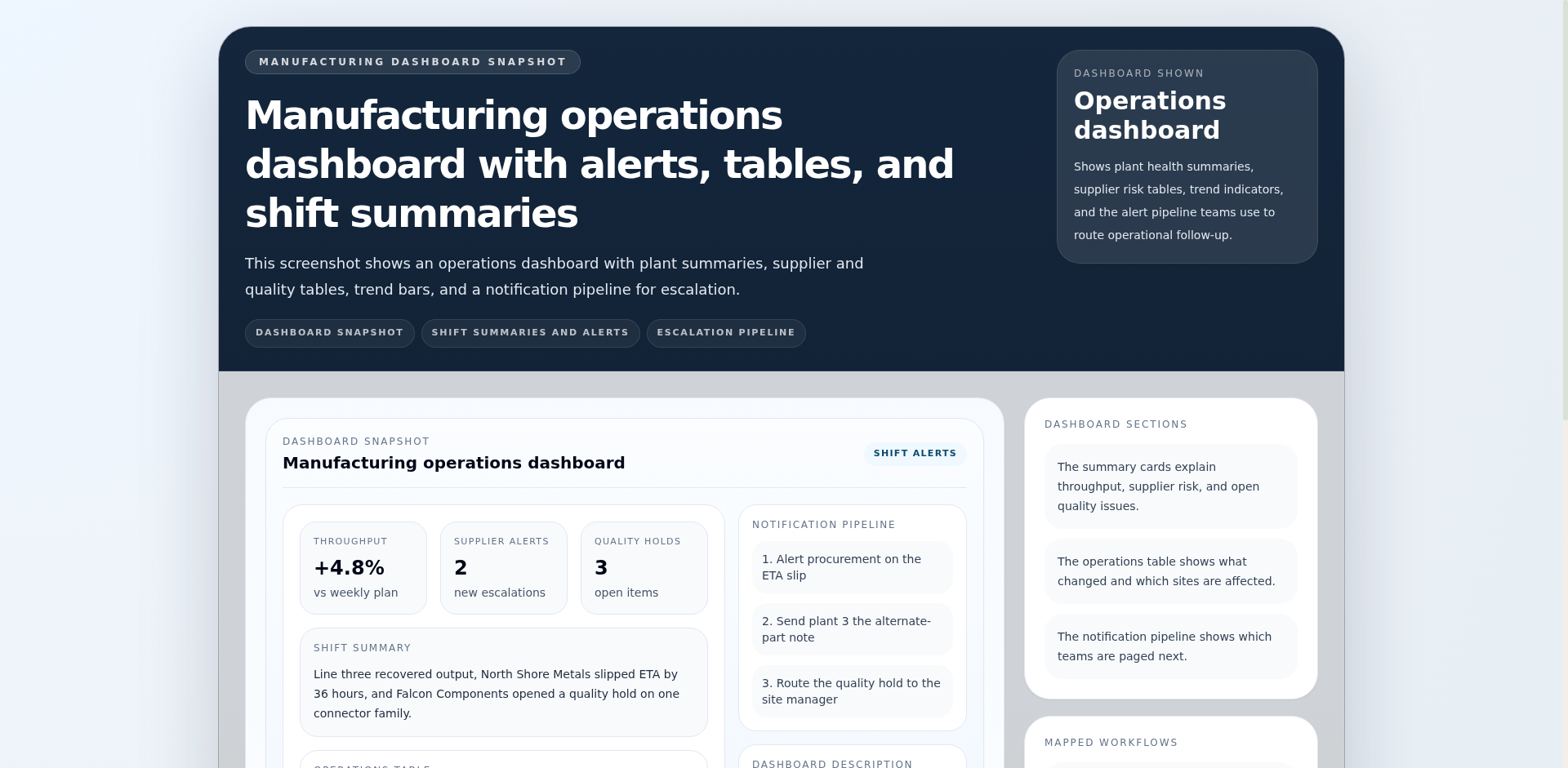
An operations dashboard showing plant summaries, supplier and quality tables, trend signals, and the notification pipeline for escalation.

Firm types and operating models
Turn repetitive KPI, throughput, downtime, and issue reporting into governed operational workflows across sites.
Maintain audit-friendly reporting, controlled procedures, and evidence-backed summaries for quality and supplier-risk work.
Connect internal systems and standardize recurring updates across distributed facilities and operating teams.
Give IT and OT teams tighter control over integrations, deployment boundaries, model policy, and restricted information access.
Different roles, one governed operating layer
Standardize recurring KPI, throughput, downtime, and exception reporting across sites and teams.
Maintain controlled procedures, evidence-backed reporting, and audit-friendly documentation flows.
Monitor supplier changes and risk signals from approved external sources without relying on unmanaged research sprawl.
Connect trusted industrial systems and supported apps while preserving network, model, and access controls.
Workflows mapped to real product surfaces
Draft operating summaries, work instructions, and internal documentation from approved plant and process context.
Track supplier, market, and regulatory signals using approved-source monitoring and controlled external collection.
Jobs-to-be-done, mapped to features and controls
This matrix turns the page strategy into implementation-ready detail, linking each role to the workflow surface, governance posture, proof destination, and conversion angle.
| Firm type | Role | Jobs-to-be-done | Elis features | Controls | Proof | CTA angle |
|---|---|---|---|---|---|---|
| Discrete manufacturers and plant operations | Operations leaders and plant managers | Standardize KPI, throughput, downtime, and exception reporting across sites. | Automations, charts and tables, SQL and API connections, report exports. | Auditable reporting and operational boundary controls. | Automate plant reporting across teams. | |
| Industrial suppliers and quality organizations | Quality and compliance managers | Maintain controlled procedures and audit-friendly documentation workflows. | Upload documents, document editor, audit systems, enterprise controls. | Retention posture, governed access, evidence trails. | Build audit-friendly reporting and document workflows. | |
| Industrial suppliers and quality organizations | Procurement and supplier-risk teams | Track supplier changes and risk signals from approved external sources. | Data collection, automations, citations, domain allowlists. | Approved-source enforcement and controlled web access. | Monitor supplier risk with approved-source workflows. | |
| Regulated production and export-sensitive environments | IT, OT, and security owners | Connect trusted industrial systems while preserving network, model, and access controls. | Supported app integrations, admin-managed datasource connections, dedicated execution. | Clearance boundaries, internet restrictions, dedicated hosting. | Deploy governed AI for industrial operations. |
Governance translated into buyer language
Real surfaces your team can inspect
Extend the same architecture into adjacent industries
The page structure is designed to expand without redesign. Adjacent industries in the same sector can reuse the same firm-type, role, control, and proof-link modules.
These sectors can inherit the same auditing systems, clearance controls, customer-managed integrations, and proof-driven workflow structure.
Bring manufacturing workflows into a governed AI stack.
Start with product exploration, then move into enterprise deployment planning when your team needs stricter boundaries, auditing systems, and managed integrations.