Track case movement, opposing-party developments, and regulatory changes with scheduled automations and evidence-backed summaries.
AI workflow automation for legal teams working under real confidentiality constraints.
Track active matters, monitor trusted sources, draft internal work product, and keep sensitive context inside governed workspaces with audit trails, clearance controls, and IT-managed data connections.
A buyer-facing workflow preview for legal teams
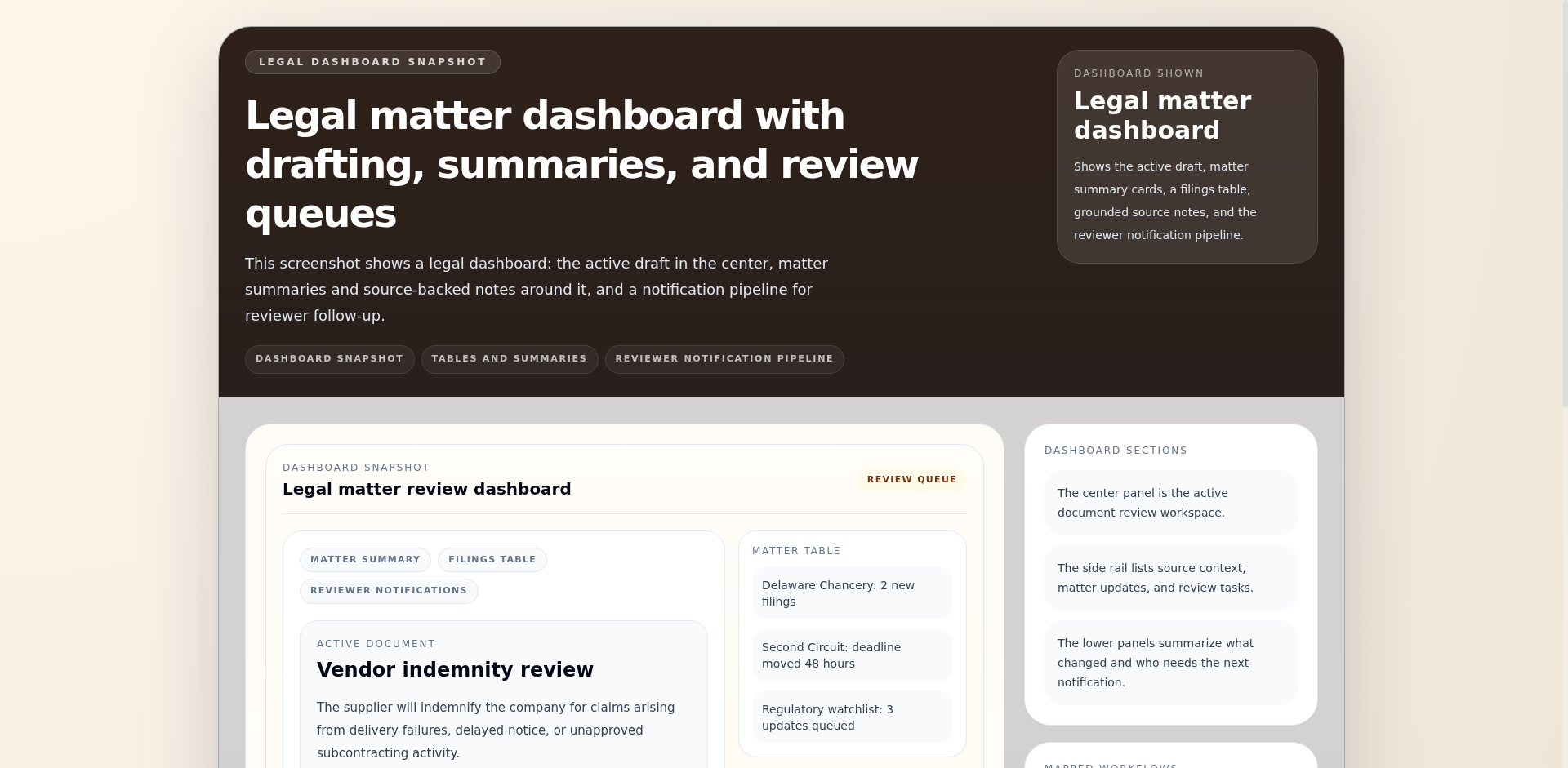
A legal dashboard showing the active draft, matter summaries, a filings table, and the reviewer notification pipeline.

Firm types and operating models
Track active matters, filings, and opposing-party developments without forcing attorneys or support staff into repetitive manual monitoring.
Support faster drafting, clause comparison, and internal precedent reuse across deal teams working with sensitive documents.
Give teams a governed way to monitor regulatory updates, preserve evidence trails, and coordinate sensitive internal work.
Bring legal reporting, contract work, and internal knowledge use under enterprise controls instead of disconnected tools.
Different roles, one governed operating layer
Receive concise, cited updates on matters, precedent, filings, and issue tracking before strategy decisions.
Build chronology summaries, research packets, and reusable matter workspaces without repetitive manual monitoring.
Standardize templates, internal knowledge reuse, and recurring research workflows across matters and practice groups.
Connect approved systems, enforce access boundaries, and choose trusted providers for legal AI workflows.
Workflows mapped to real product surfaces
Draft agreements, internal memos, and client-ready updates using approved matter documents and reusable internal knowledge.
Let legal IT teams connect approved apps, databases, and provider accounts while keeping model and access policies centralized.
Jobs-to-be-done, mapped to features and controls
This matrix turns the page strategy into implementation-ready detail, linking each role to the workflow surface, governance posture, proof destination, and conversion angle.
| Firm type | Role | Jobs-to-be-done | Elis features | Controls | Proof | CTA angle |
|---|---|---|---|---|---|---|
| Litigation firms and trial teams | Partners and lead litigators | Monitor active matters, review cited briefings, and turn case movement into internal decisions. | Automations, trusted-source search, citations, report exports. | Audit trails, domain restrictions, matter-level confidentiality. | Monitor matters with governed research. | |
| Litigation firms and trial teams | Paralegals and litigation support | Assemble chronology summaries, research packets, and reusable matter workspaces. | Projects, upload documents, automations, citations. | Project-scoped access and workflow evidence. | Support case prep without losing control. | |
| Corporate and transactional firms | Transactional attorneys | Compare clauses, summarize diligence, and draft client-ready work product. | Document editor, uploaded documents, internal grounding. | Controlled document access and cited internal workflows. | Draft faster with controlled internal grounding. | |
| In-house legal departments | Legal operations and IT or security | Connect approved systems, standardize reporting, and centralize provider and policy choice. | SQL and API connections, supported app integrations, BYOK and BYOA. | Clearance controls, allowlists, dedicated deployment, audit systems. | Bring legal AI under enterprise control. |
Governance translated into buyer language
Real surfaces your team can inspect
Extend the same architecture into adjacent industries
The page structure is designed to expand without redesign. Adjacent industries in the same sector can reuse the same firm-type, role, control, and proof-link modules.
These sectors can inherit the same auditing systems, clearance controls, customer-managed integrations, and proof-driven workflow structure.
Bring legal workflows into a governed AI stack.
Start with product exploration, then move into enterprise deployment planning when your team needs stricter boundaries, auditing systems, and managed integrations.